Saturday, September 11, 2010

Images From a Game Preserve

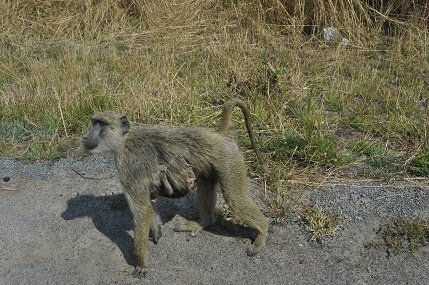
We drove through a game preserve on our way to Iringa.  Here are a few images of that drive:

Majestic and Graceful
Momma and Baby

The Big Potato

We have a saying in the West about being the big shot or top dog. That translates somewhat differently in TZ. Mark Jensen was the founder of the Ag Institute at Tumaini University in Iringa. Mark is well known and receives the best treatment by all the locals. In fact, when staying in a remote village Mark will always get the best room. He has been named The Big Potato.


Now that Mark isn’t in TZ as much due to illness, a new Big Potato has emerged. Don has taken on that mantel in Mark’s absence. When we visited the rice broker, we were given 1.2 million TZ Shillings as the first payment for our sold rice. Here Don sits as a millionaire and the Big Potato since he was given the money to safeguard.

We can have some fun with this!

Impressions of Dar Es Salaam

Traditional and Modern Dress
Dar is a city of nearly 4,000,000 people. There are only a few roads through town and sometimes there was only 1 road you could take to get to your destination. When trying to drive to the rice market, we sat in absolute grid lock on the road for nearly 2 hours. In the course of 2 hours we traveled about 3 or 4 miles. There is such a lack of infrastructure in most of the city.


An advantage to sitting dead still in traffic is that you are approached by the “walking Walmart” of street vendors. We saw people selling toothpaste, gum, cell phone charges, water, shoes, shirts, peanuts, fruit, maps, newspapers, etc. It was quite entertaining to see what would be brought to your window next.

We went for walks from the hotel on two nights before dinner. The sidewalks are covered with street vendors selling all varieties of things. Used clothing is a big item. Most of this seems to come from the US based on style and tee shirt messages. Also, there were several “book stores” spread out on blankets on the sidewalks. The books tended to be in the English language. There was a nice selection of Spanish Bibles at one location. I’m not sure how much demand there is in TZ for Spanish Bibles. One of my favorites was a 1960 vintage book explaining to pastors’ wives how they could be a pastor’s wife and still have a fulfilling life.  I’m not sure of the demand for that title in TZ, but someone was trying to sell it.

I’ve been told that much of the used clothing sold in TZ comes from US groups like the Salvation Army and Goodwill. What doesn’t sell in their US stores is sold in bulk to a wholesaler in India. This guy has a network of agents in the countries that rim the Indian Ocean. These agents distribute to the street vendors who try to sell whatever merchandise they get. I wonder if the books sold on the street are the leftovers from what Books for Africa can’t use in school programs.

Dar Es Salaam, and maybe all of TZ, seems to function on human power. This is good in that it provides more employment for more people, even if wages are low. We are so accustomed to seeing big machines moving dirt to get a sewer in place that watching humans with shovels doing the work seems strange and not productive. One of my favorite memories of Dar was watching a furniture delivery man. He had a full size sofa balanced on a bicycle and was pushing it down a busy street to make his delivery. The bicycle and the 2-wheel hand cart provide the vast majority of local deliveries in Dar.

So Where Has Tom Been?

It’s now Saturday, September 11, and I’m in Iringa. Here’s what’s happened so far. I left Minneapolis on Monday, September 6. The flights from MSP to Amsterdam and Amsterdam to Dar Es Salaam were lengthy and uneventful. On the second flight we stopped in Arusha, TZ to drop off people going on safari or climbing Mt. Kilimanjaro and pick up those who had finished those adventures. We landed after dark so there was no chance to see the mountain. That was a disappointment.


We are so accustomed to everything happening with orderly precision according to plan. We are used to leaving Minneapolis on an early flight and having an afternoon meeting in Boston or Denver. Well things don’t always work that smoothly. The original plan was to spend one night in Dar and then drive to Iringa. At the last minute, we got an email that we needed to meet with a rice broker and stay one extra day in Dar to pick up two people who also needed to travel to Iringa. Well, there was some miscommunication about when Roger and Verna were leaving the US and arriving in Dar. So we stayed another day in Dar to see if they arrived on the next day’s flight. Yes! They arrived Thursday night and bright and early Friday morning we started the 8 hour drive to Iringa.

The rice broker visit was most interesting. Business is done somewhat differently in TZ. One of the farms we will visit grows rice. They harvested and delivered about 10 tons of rice to this rice broker. He shook hands with our person and said to come back in a few weeks to pick up the money for any rice he sold. There was no written contract, just a handshake. So, when we met with him, he handed over the first payment for rice sold. He had bags of rice from 100s of producers. I have no idea how he keeps track of how much rice was sold for our farm. There wasn’t a computer, calculator or spreadsheet anywhere to be found.

I took very few pictures in Dar since we were warned about theft and muggings. When you consider that the camera I carry might represent 1 or 2 year’s salary for the average worker, the prudent person might leave the camera back in the hotel.

Sunday, September 5, 2010

Map of Iringa Region


Here is a map of the majority of Iringa Region.  Many of the villages we will visit are shown on this map

So, Where is Tanzania?

Habari (Hello):

I am asked two questions when I mention my adventure which begins tomorrow:

    1.  Where is Tanzania?
    2.  Why am I going?

The map should help locate Tanzania.  It is in Central East Africa with Kenya to the north and Mozambique and Zambia to the south.  The Indian Ocean is to the east.  It is a country of about 38 million people.  We will be working out of the city of Iringa.  Iringa is the transportation, education and business hub of the Iringa Region (similar to a state in the US).  The city has a population of about 100,000.

The "Why" question may be more elusive.  Certainly there will be adventure and new sites.  The idea of an animal safari is intriging to any guy who grew up with Tarzan movies and visions of Africa drawn by missionaries supported by churches.  I'd like to get close enough to some animals to get good pictures, but no closer.  The rest of the "Why" question will unfold over the 3 weeks.

Kwa Heri (Goodbye)

Saturday, September 4, 2010

The Corn Sheller Man

So, I was all relaxed.  I had packed my bag and discovered I could get everything I needed to bring to Tanzania into one medium sized suitcase, plus my small carry-on bag.  That was good.  Then, I got 2 phone calls.  First, could I bring a laser printer toner cartridge since the current one is out of toner?  Second, could I bring along some corn shellers?  I didn't know what a corn sheller looked like.  I agreed to both requests.

Bring out the second suitcase.  The toner cartridge was larger than I expected, but wasn't really a big problem. Then, I got a box of 50 metal corn shellers (see the picture on the left).  The second suitcase is now ready to go.  It's heavier than my original one which held everything I needed to take to TZ.

I'm not sure how I will explain 50 corn shellers to the security people as I pass through customs in Amsterdam or when I attempt to enter Tanzania.

The adventure begins.